
Meta Ads vs TikTok Ads for E-commerce: Which is Better in 2026?
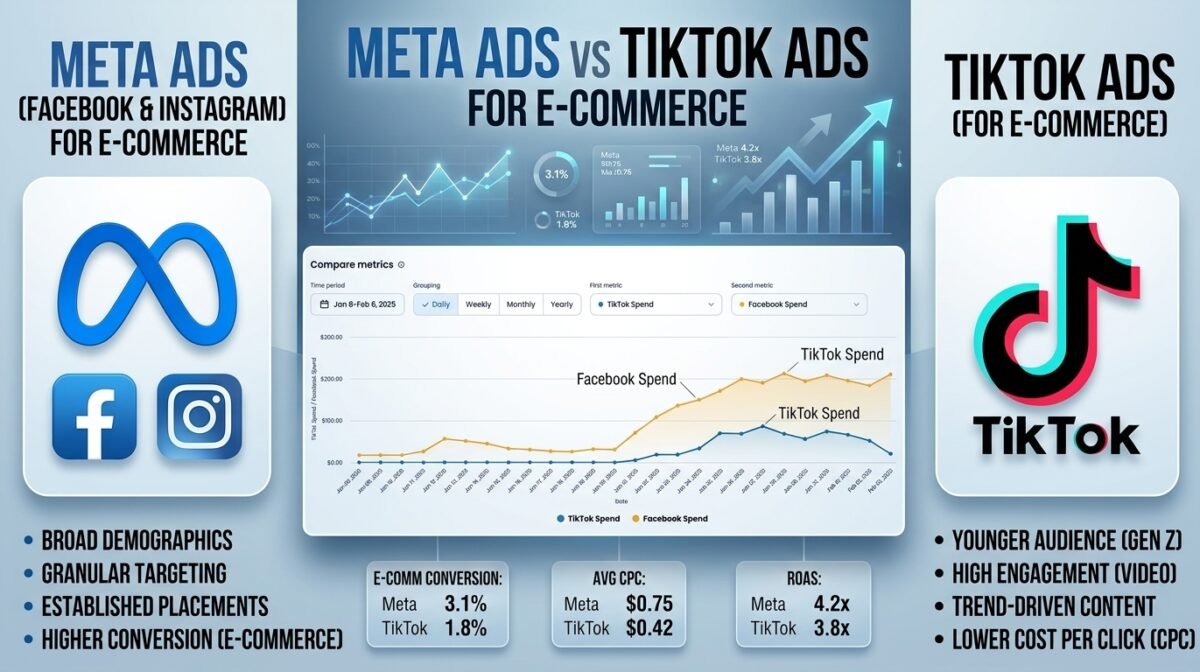
Meta Ads vs TikTok Ads for E-commerce is the core strategic comparison every online store owner must make when allocating paid acquisition budgets.
Choosing between Meta (Facebook & Instagram) and TikTok Ads requires understanding how both ad ecosystems generate scale and profitability. While both platforms offer billions of active users, their algorithms, targeting capabilities, and user behaviors differ drastically. Allocating funds to the wrong channel can lead to high acquisition costs and depleted marketing budgets without generating a sustainable Return on Ad Spend (ROAS).
Meta Ads: The High-Intent Conversion Powerhouse
Meta remains the foundational backbone of paid social advertising due to its unmatched machine learning algorithms and deep demographic reach across Facebook and Instagram.
- Primary Audience: Broad demographics spanning ages 25 to 55+.
- Ideal Product Types: Mid-to-high ticket products ($50–$300+), subscription boxes, household goods, and classic retail.
- Key Strength: Advanced Meta Pixel and Conversions API (CAPI) tracking that excels at retargeting high-intent shoppers.
- Primary Drawback: Higher Cost Per Mille (CPM) compared to newer short-form video competitors.
Meta performs best when you have proven product-market fit and want predictable scale through dynamic product ads (DPAs) and broad conversion funnels.
TikTok Ads: Rapid Engagement & Impulse Virality
TikTok has transformed from a short-form video feed into an e-commerce discovery engine, heavily accelerated by TikTok Shop and User-Generated Content (UGC).
- Primary Audience: Active Gen Z and Millennial consumers (ages 18 to 34).
- Ideal Product Types: Impulse purchases under $50, visual or lifestyle goods, beauty items, fashion, and trending gadgets.
- Key Strength: Lower Cost Per Click (CPC) and viral reach potential using organic-looking video formats.
- Primary Drawback: Faster creative fatigue requiring new ad angles every 7 to 14 days.
TikTok thrives on raw, authentic video creative. Ads structured like organic TikTok videos—rather than polished corporate spots—consistently achieve the lowest cost per acquisition.
Meta Ads vs TikTok Ads for E-commerce: Head-to-Head Comparison
| Feature | Meta Ads (Facebook & Instagram) | TikTok Ads |
| Primary Audience | Ages 25 – 54+ | Ages 18 – 34 |
| Top Performing Formats | Carousels, Single Images, Instagram Reels | Native UGC Video Ads, TikTok Shop Ads |
| Average CPM & CPC | Moderate to High | Low to Moderate |
| Purchase Intent | High (Retargeting Advantage) | Medium (Impulse Driven) |
| Creative Lifespan | Moderate (3–6 Weeks) | High Fatigue (1–2 Weeks) |
| Tracking Accuracy | Superior (CAPI + Pixel) | Moderate (Stronger within TikTok Shop) |
Evaluating Core Performance Factors
1. Ad Spend Efficiency and CPM Rates
Comparing Meta Ads vs TikTok Ads for E-commerce shows distinct cost advantages at different stages of the marketing funnel. TikTok offers significantly lower CPMs, allowing brands to test product concepts and hooks affordably. However, Meta’s higher CPMs are offset by stronger buying intent and higher average order values (AOV).
2. Targeting Precision
Meta relies on years of behavioral tracking, intent metrics, and lookalike audiences. Its Conversions API leads the industry in predictive purchase matching. TikTok targeting centers around content consumption trends, hashtag interactions, and niche engagement clusters.
3. Creative Production Demands
- Meta: Accommodates flexible ad formats, including catalog feeds, static graphic overlays, and direct-response reels.
- TikTok: Demands native video production with strong 3-second hooks, fast pacing, and authentic creator scripts.
Final Verdict: Which Ad Platform Should You Use?
Choosing between Meta Ads vs TikTok Ads for E-commerce depends on product price point, video creation capabilities, and growth stage:
- Pick Meta Ads if: You sell higher-priced items, need robust retargeting infrastructure, and want stable, long-term conversion rates.
- Pick TikTok Ads if: You target under-35 audiences, sell low-ticket impulse goods ($15–$50), and maintain a continuous pipeline of UGC video creative.
- The Recommended Hybrid Approach: Use TikTok Ads for top-of-funnel (TOFU) awareness to capture low-cost impressions, then retarget those visitors at the bottom of the funnel (BOFU) using Meta Ads across Instagram and Facebook.